The Life of Saint Martin · Chapter X
The bishop who lived in a wooden hut: The founding of Marmoutier
Once he had become bishop, I can hardly find words to describe the greatness of soul that Martin showed. He went on being exactly the same man he had always been: the same humility of heart, the same poverty in his way of dressing. Full of natural authority and grace, he carried out the responsibilities of a bishop to the full without ever giving up the simple, austere life of a monk.
In the early days he still lived in a small room adjoining the city’s church. But since he could not stand the constant stream of people coming to knock at his door, he decided to found a monastery about three kilometres from Tours. The spot was so quiet and hidden that it seemed like the desert itself: on one side rose the sheer wall of a rocky cliff; on the other, the river Loire embraced the little plain in a gentle curve. There was only one path to get there, and even that was very narrow.
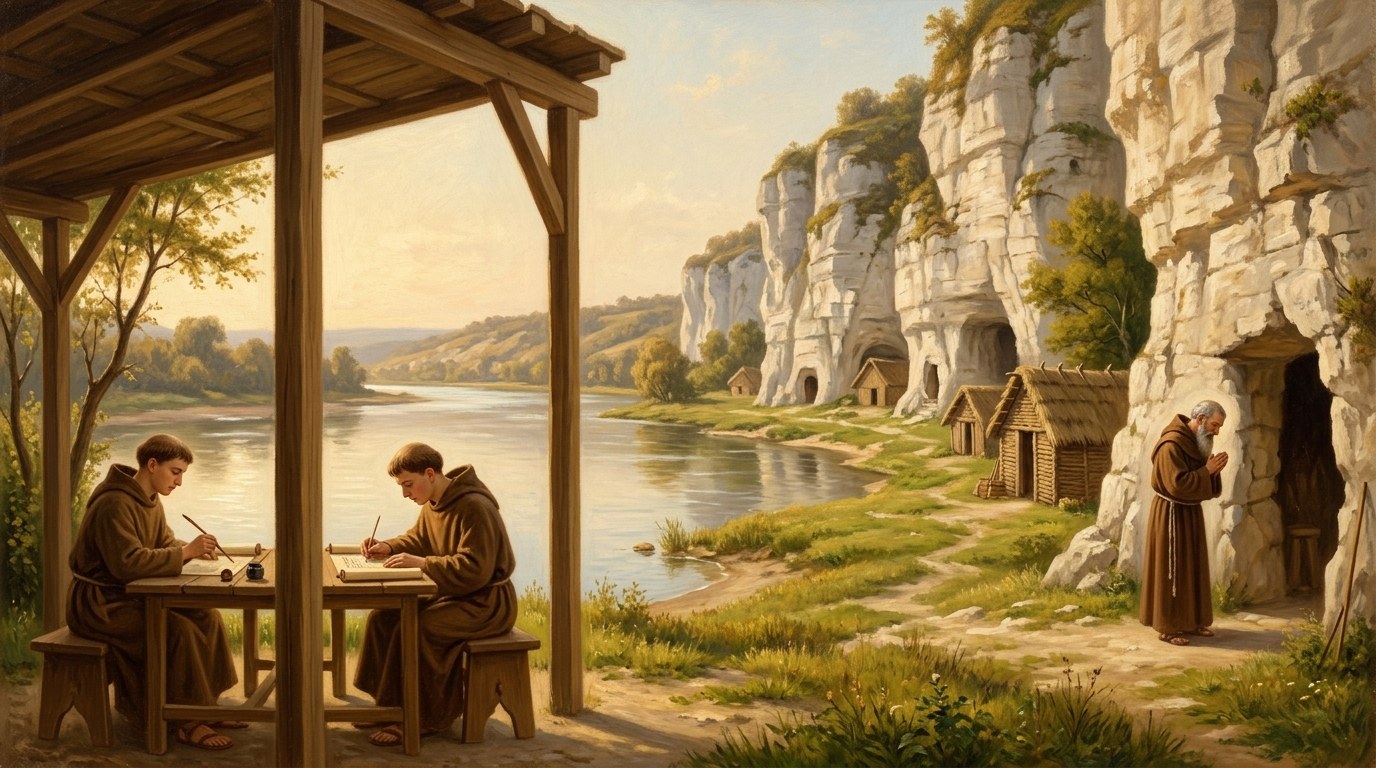
Martin built himself a simple hut of wood and woven branches, and several monks did the same; most, however, dug their shelter directly into the soft rock of the hillside. Eighty disciples lived there, all committed to following the example of their master. No one owned anything; everything belonged to everyone, and it was forbidden to buy or sell anything whatsoever, contrary to what many other monks were already doing.
No one there practised a manual trade, with one single exception: the copying of books — a task given to the youngest, so that the older ones could devote themselves full-time to prayer. Hardly anyone left his cell, except at the hour of praying together. They all took a single meal in common at the end of the day, once the fast was over, and no one drank wine unless he was ill and needed it as medicine. Almost all wore rough tunics of camel hair; wearing soft fabrics was considered a serious fault there — which is all the more impressive if we remember that many of those monks came from noble families, had been brought up in comfort and chose this hard and humble life of their own free will. Later we saw several of them become bishops; after all, what city or what diocese did not dream of having at its head a priest trained in Martin’s monastery?
The refuge that Martin created two Roman miles (about 3 kilometres) from Tours, wedged between the limestone hillside and the river Loire (Liger), would become the famous Abbey of Marmoutier (Maius Monasterium). The rock of that bank of the Loire is tuffeau, a white limestone that is easy to dig, where you can still visit today the caves opened by Martin’s monks!
There are two details in this chapter with an enormous impact on European history:
1. Exclusive dedication to the copying of books (scriptores): While the monks of the Egyptian deserts wove baskets or ropes to earn their bread, Martin created at Marmoutier a rule that was new in the West: the only manual work of the monastery was copying books by hand. By setting the youngest monks to transcribe manuscripts, Martin sowed the seed of the future medieval scriptoria that would save a large part of ancient and Christian culture during the fall of the Roman Empire.
2. A nursery of new bishops: By attracting young men of the Roman aristocracy (nobiles) to a life stripped of possessions and devoted to the study of the Scriptures, Marmoutier turned into a real spiritual school from which came many of the bishops who renewed the Church in Gaul.