The Life of Saint Martin · Chapter XXIV
The false Christs in Hispania and the Devil dressed as Emperor: “I will not recognise Christ without the marks of the Cross”
As it happens, it was noticed that in those same years there appeared in Hispania a young man who, after winning fame among the people with various wonders, became so puffed up with vanity that he began by saying he was the prophet Elijah. As many people believed him without asking questions, he took a further step and started declaring that he was Christ himself — deceiving so many that even a bishop called Rufus knelt to worship him as though he were the Lord, a scandal that later cost him his office as bishop. Several brothers also told us that, at exactly the same time, another man had arisen in the East claiming to be Saint John. Seeing false prophets of this kind appear everywhere, one can well understand that the coming of the Antichrist cannot be far off, and that he is already preparing the ground through these figures.
But I cannot fail to tell here how subtly the Devil tried to deceive Martin himself at about that same time. One day, while Martin was praying alone in his cell, there appeared, standing before him, a figure bathed in and surrounded by a blaze of purple light — designed down to the last detail to dazzle the onlooker with that false brilliance. He was wearing an imperial robe, on his head a crown of gold set with precious stones, on his feet shoes overlaid with gold, and he had so serene an air and so radiant a smile that he looked like anything but the Devil.
Coming face to face with that dazzling apparition, Martin was at first left without reaction, and for a good while no one said a word. In the end it was the Devil who broke the silence: “Recognise, Martin, who it is that stands here before you! I am Christ: as I am about to come down to earth, I wanted to appear to you first.”
Martin remained silent, answering him nothing. The Devil then returned to the charge, bolder still: “Martin, why do you hesitate to believe, when you see me with your own eyes? I am Christ!”
At that point, enlightened inwardly by the Holy Spirit to understand that he had before him the Devil and not the Lord, Martin answered him: “The Lord Jesus never said that he would return dressed in purple and with a royal crown on his head. I will never believe that Christ has come unless I see Him with the appearance and the features with which He suffered in the Passion, bearing on His body the marks of the Cross!”
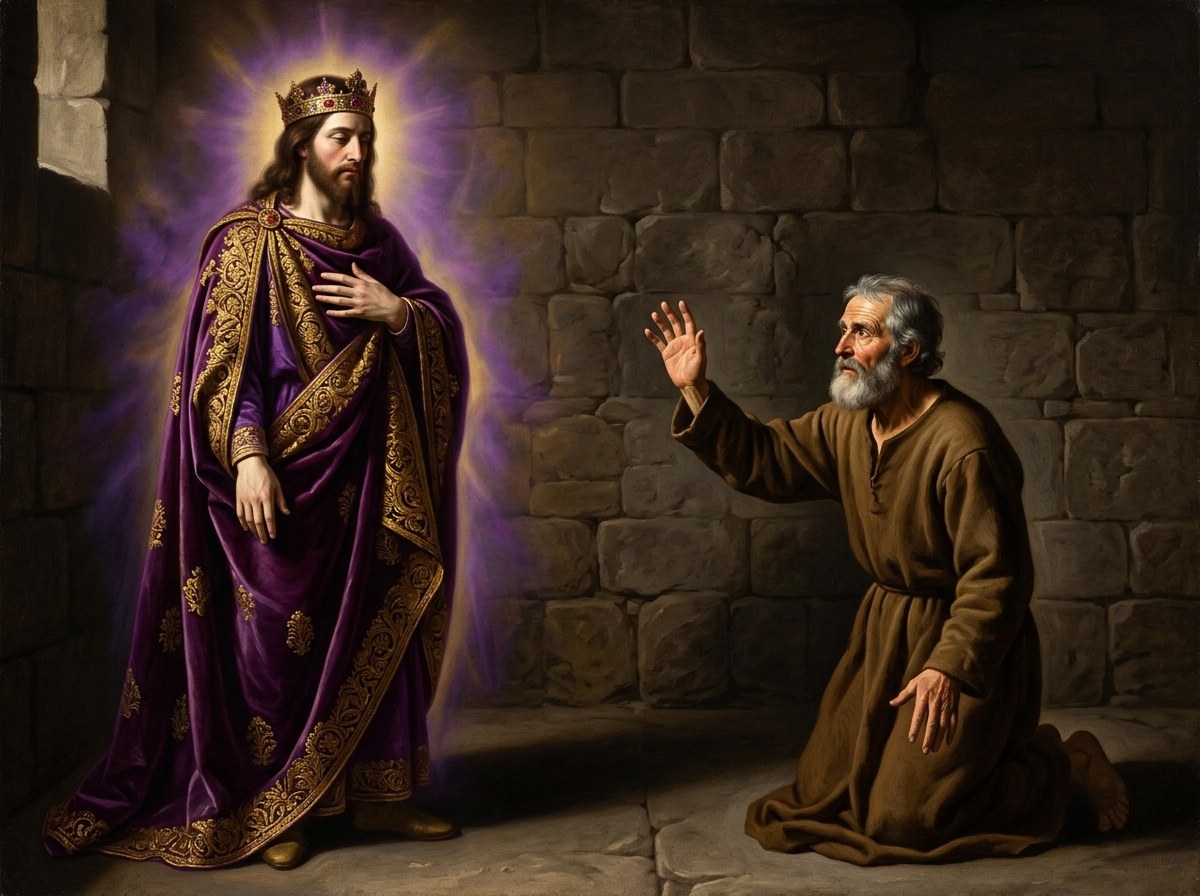
No sooner had he heard these words than the figure dissolved in a second like smoke, leaving the cell filled with so nauseating a stench that there remained not the slightest doubt that it really was the Devil. And so that no one should think this is some invented legend, let me say at once that I heard this story, exactly as I have just told it, from Martin’s own lips.
For many historians and thinkers, this Chapter XXIV — told directly by Martin to Sulpicius Severus — is the most profound and topical page of the whole biography.
Notice first the mention of Hispania (the present-day Iberian Peninsula): at the end of the fourth century an intense end-of-the-world atmosphere prevailed in the Iberian provinces, to the point where a local bishop called Rufus let himself be carried away by a charlatan who claimed to be Christ.
But notice above all the clothes the Devil chooses in order to pass himself off as Jesus: a purple robe (vestis regia), a diadem of gold and precious stones (diadema) and footwear covered in gold (calcei auro illiti). Piece by piece, it was the ceremonial dress of the Roman Emperors of the fourth century! As the Empire became officially Christian, many bishops used to palaces were beginning to imagine Christ as an Imperial Monarch, all gold and earthly triumph. Martin’s answer crosses the centuries like a flash of lightning: a Christ full of luxury and power, cut off from those who suffer and without the wounds of the Cross, is a forgery. For Martin, the true face of Christ remains that of the poor, freezing man to whom he gave half his cloak at the gates of Amiens.