The Life of Saint Martin · Chapter II
From Pannonia to Italy: The boy who ran away to church and was taken to the army in chains
Martin was born at Sabaria, a town in the province of Pannonia, but grew up in Italy, at Ticinum. His family had a good social standing by the standards of the time, but his parents were pagans. His father had begun his military life as a simple soldier and had later risen to the rank of military tribune.
In his youth Martin himself followed the career of arms, serving in the cavalry of the imperial guard during the reign of the emperor Constantius and then under the command of the Caesar Julian. It was not, however, by his own choice: from a very early age that extraordinary boy thought of nothing but serving God. He was only ten years old when, against his parents’ wishes, he ran away to a church and asked to be accepted as a catechumen. A short time later, already wholly turned towards the things of God in a way that was striking for his age, at twelve he dreamed of going to live as a hermit in the desert — and he would have done so had he not still been so young and frail. Even so, with his mind always on monasteries or the church, he already carried in his heart as a child what he would later carry out with such dedication.
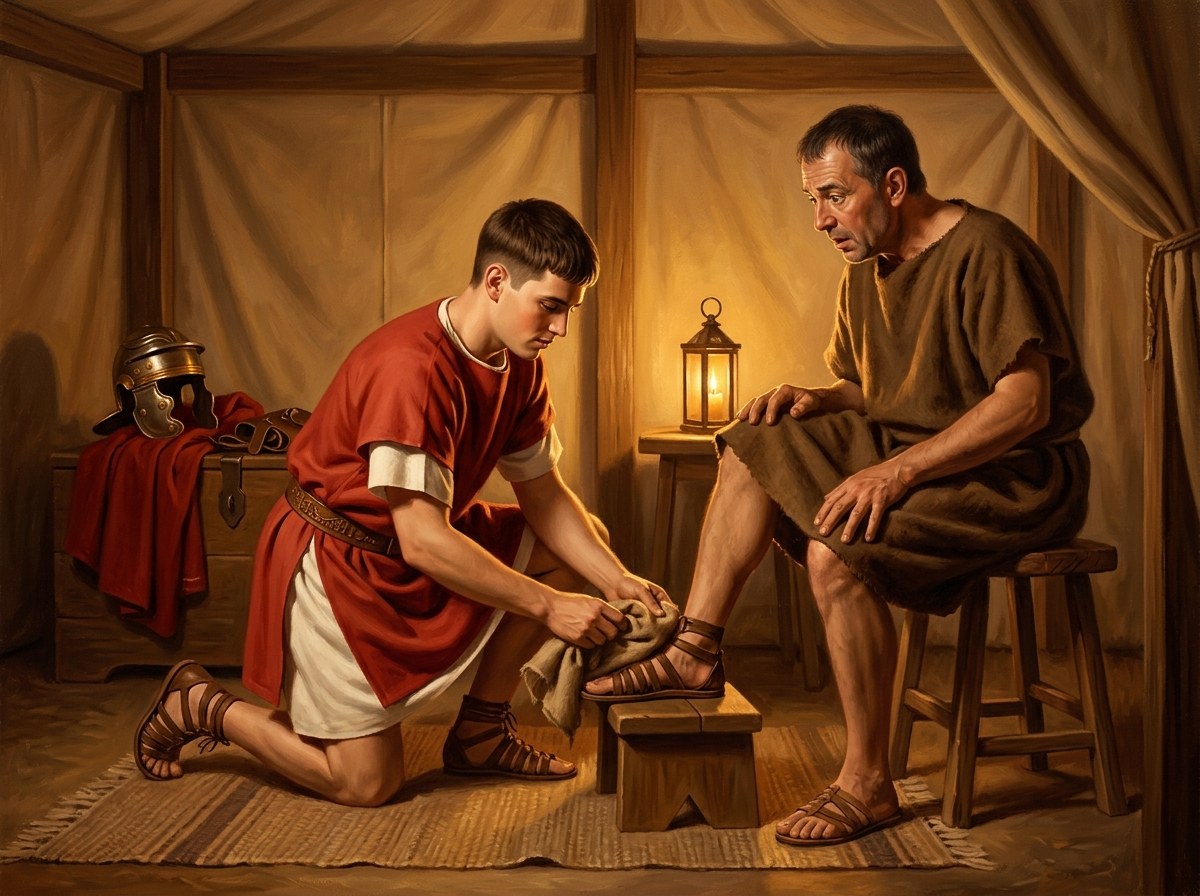
Meanwhile, the emperors issued a decree obliging the sons of veterans to enlist in the army. Martin’s own father — who could not bear to see his son’s religious leanings — denounced him and handed him over to the authorities. That is how, at just fifteen, Martin found himself arrested, put in chains and forced to take the military oath. He took with him only one slave to attend him, but he completely reversed the usual roles: it was the master who served the servant. More often than not it was Martin himself who took off the man’s boots and cleaned them, and the two of them sat down to eat together at the same table, almost always with Martin serving the meal.
He spent almost three years in the army before being baptised, but he always kept well away from the vices into which soldiers usually fall. He treated his comrades-in-arms with immense kindness and uncommon generosity, and he had a patience and a humility that seemed beyond human strength. As for the simplicity with which he lived, there is no need even to praise it: he led so austere a life that, even then, he seemed more like a monk than a soldier. With this way of being he so won over his fellow soldiers that they all felt enormous respect and affection for him.
Even without yet having received baptism, he was already living in practice as a true Christian by the works he did: he helped those in difficulty, came to the aid of the most wretched, gave food to the hungry and clothes to those who had nothing to wear. Of his army pay he kept nothing for himself beyond what was needed to eat each day; even then he took the words of the Gospel seriously and did not worry about tomorrow.
There are several fascinating historical details here about the fourth century:
1. Geography: Sabaria, where Martin was born (in 316 according to the traditional chronology, or around 336 according to more recent studies), is the present-day city of Szombathely, in Hungary, which was part of the Roman province of Pannonia. Ticinum, where he grew up, is today Pavia, in northern Italy, at that time an important military town.
2. The tribune father and the denunciation at home: Martin’s father had worked his way up through the Roman army: he had started as a common soldier (miles) and had reached the rank of military tribune (tribunus militum), a senior officer with equestrian status and a good income. In the late Roman Empire, since there were never enough men to defend the frontiers, the State created hereditary laws obliging the sons of veterans to follow the career of arms. For an old pagan officer, devoted to the gods of war, seeing his 15-year-old son want to be a Christian monk was an unacceptable disgrace — and so it was the father himself who handed him over to the recruiters to be led away in shackles!
3. The Palatine Guard (scholares alae): Martin did not end up in an ordinary infantry unit, but in the Scholae Palatinae, the elite cavalry that formed the personal escort of the Emperor (Constantius II, son of Constantine) and of the Caesar (Julian). These were prestigious troops, well paid and entitled to a personal servant.
4. What was a “catechumen”? In the fourth century, babies were rarely baptised. Anyone who wanted to become a Christian first entered the catechumenate — a stage of several years of spiritual preparation and moral testing.
5. The reversal of roles with the slave: In Roman society, pulling off the heavy military boots (caligae or calciamenta) and scraping the mud from them was a slave’s lowest task. To see a young officer of the imperial guard clean his own servant’s boots and wait on him at table was something completely unthinkable to the mentality of the time.