The Life of Saint Martin · Chapter V
Saint Hilary of Poitiers, the office of exorcist and the robbers’ ambush in the Alps
As soon as he left military life, Martin went to find Saint Hilary, bishop of Poitiers, a man whose faith and religious wisdom were at that time admired by everyone, and stayed with him for a while. Hilary wanted to keep him close and bring him into the clergy of the diocese by ordaining him deacon. But Martin refused time after time, insisting that he was not worthy of so great an office. Hilary, who was a man of enormous insight, saw that there was only one way to persuade him: to give him a role so modest that it would look almost like a demotion. So he proposed that he become an exorcist; and this time Martin accepted, so as not to give the impression that he despised the post for being too humble.
A short time later, he felt warned in a dream that he should go and visit his homeland and his parents, who were still attached to paganism, to try to help them towards the faith. He set off with the permission of Saint Hilary, who let him go only after extracting from him, with pleas and tears, the promise that he would return. Martin is said to have taken to the road with a heavy heart, warning his companions that he was going to meet with many hardships — which the journey quickly confirmed.
To begin with, while taking some lonely short cuts on the crossing of the Alps, he fell into an ambush of bandits. One of them actually raised his axe to split his head open, but another robber checked his arm at the last moment. Even so, they tied his hands behind his back, robbed him of what he was carrying and left him in the charge of one of the men of the gang. This man took him to an out-of-the-way spot and began to ask him who he was. Martin answered that he was a Christian. The robber asked him whether he was afraid. Perfectly calmly, Martin assured him that he had never felt so safe in his life, because he knew that God’s protection never fails, above all in moments of greatest danger; and he added that he felt sorry rather for him, who, by being mixed up in a life of crime, was cutting himself off from the mercy of Christ.
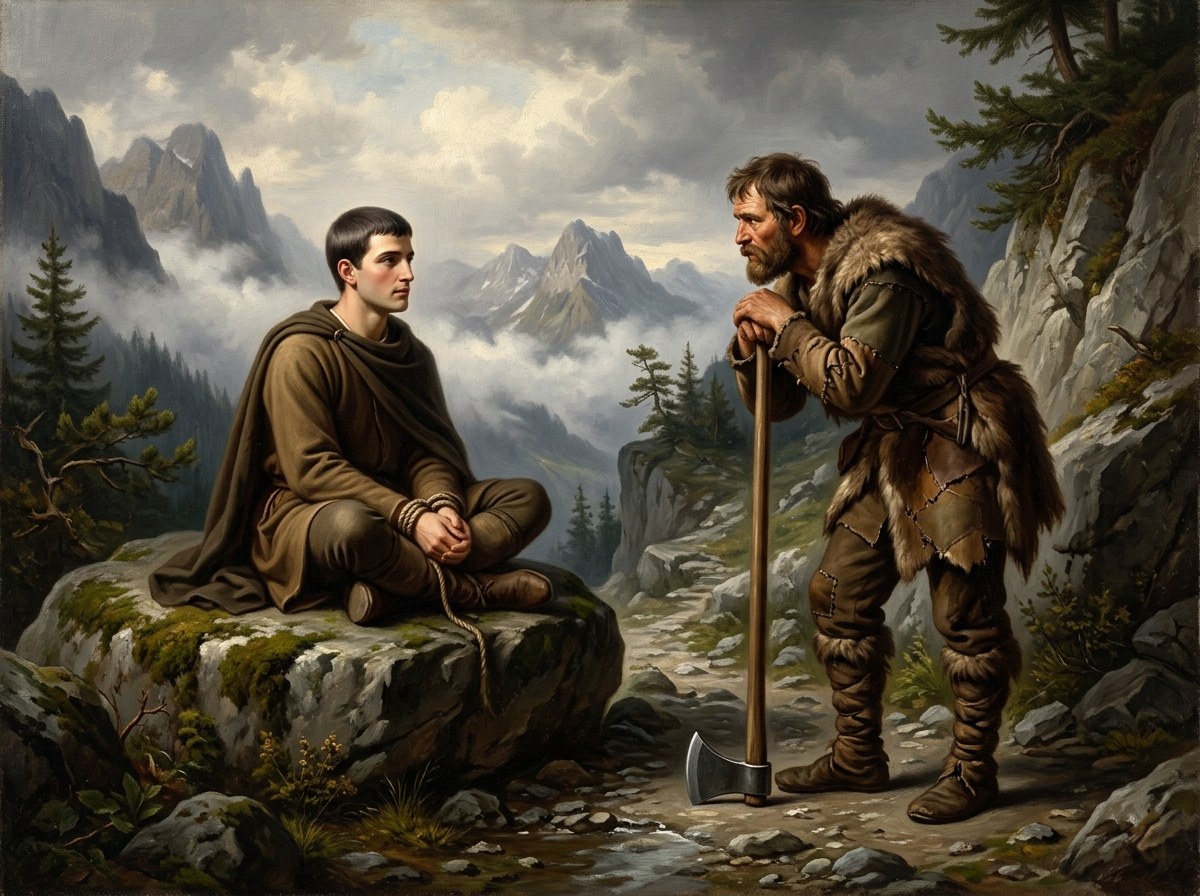
There and then he began to explain the Gospel to him and to speak to him of the word of God. There is no need to spin the story out: the thief believed what he heard, accompanied Martin until he had left him safely back on the main road, and took his leave asking him to pray for him. Later it became known that this man had changed his life completely and entered the religious life — indeed, this whole episode is said to have come down to us from his own lips.
Saint Hilary of Poitiers (c. 315–367) was the great intellectual authority of the Church in Gaul — a remarkable theologian and Martin’s true spiritual master.
There is a detail in this chapter that tends to puzzle anyone who watches horror films today: why did Martin refuse to be a deacon because he thought himself unworthy, but accept being an exorcist because it was a humble role? In the fourth-century Church, deacons were the bishop’s right hand: they managed the accounts of the diocese, organised support for the poor and carried enormous social weight. The exorcist, by contrast, belonged to the so-called “minor orders”: it was a discreet, subordinate task, devoted to accompanying the catechumens, looking after the church and attending to disturbed people, or those held to be possessed, who lived on the margins of the community. Hilary used brilliant psychology: he saw that a prestigious office would make Martin run away, but that he would never refuse the lowest rung of the church, for fear of seeming proud!